
“Which Promo Cards are legal?”
This simple question doesn’t always have a simple answer. Promo cards aren’t part of any major set. They release sporadically and confusingly, one or more at a time, between sets. When we play “Base–Fossil,” we generally consider the legal card pool for the format to comprise all English cards released by Wizards of the Coast (WotC) prior to the release of Team Rocket, since Team Rocket was the next major set released after Fossil. How do we know which promos those were, though? They have promo numbers in the corner, sure, but those promo numbers don’t always reflect their true release order. WotC commented on this phenomenon in a May 2000 live chat, stating, “Different promotional cards are worked out with different promotions and companies and they all work at different rates. Some just make it to market earlier than others.”
For instance, many players new to the format are surprised and confused when they learn that Eevee promo #11 isn’t legal in Base–Fossil. Why not? Was it banned? Not exactly. The truth is, Eevee promo #11 was never part of the Base–Fossil card pool to begin with—it didn’t release until two months after Team Rocket! And yet, promos 12–15 were released before Team Rocket. This is why we say the legal promos for Base–Fossil, at least as we play it, are 1–10 and 12–15, but not 11.
To shed some light on this and other such anachronistic enumerations of the Wizards Black Star Promo cards, I’ve put together this timeline of English release dates and distribution methods. Before I get started, though, I want to make a few things clear:
- I’m only discussing English cards here. Japan got their promos in a different order, which is just one of many ways their Base–Fossil equivalent format was different from ours—but that’s an article for another day. The same goes for other languages—Spanish, German, Korean, etc.
- All release information, unless otherwise specified, applies strictly to distribution within the continental United States of America. WotC has always been based in the US, and with very few exceptions, it’s where they released cards first—and those cards were in English. Other regions and languages got their cards on different schedules and through different methods, which are beyond the scope of this article.
- Promos were legal for tournament use as soon as they were released. However, release dates could be fuzzy—and I don’t just mean “fuzzy” as in “difficult to determine in hindsight,” though that’s often painfully true as well. The fact is, promo distribution was not (in all cases) consistent from store to store, city to city, state to state. Some promos got delayed by WotC. Some promos got delayed by other companies, leaving WotC shrugging their shoulders when asked about them. Some stores’ leagues were run way behind schedule and didn’t give out promos until much later than others. Some magazine promos didn’t show up in the issues they were supposed to for some customers, but did for others. It was chaotic. I’ll do my best to provide accurate release dates, with supporting evidence when available, but expect some vagueness and uncertainty.
- I don’t know everything, and I’m not infallible. There may be gaps in my knowledge, and I may make some incorrect assumptions based on faulty data. If and when mistakes or new information are discovered, though, I will promptly edit this article to reflect that. Believe me when I say that nothing excites me more than learning new information!
With all that out of the way, let’s get started! Since this is a timeline, cards will be listed in chronological order of initial availability. First, to make it easier to jump around as you like, here’s a quick table of contents with links to each card. There were no Base Set era Black Star Promo cards in English, so we’ll begin with the Jungle era and work our way forward. Click to expand the accordion list and see the promos available within the era, then click the promo to jump to its entry.
Jungle Era Promos
1999-06-16 through 1999-10-09

#1: Pikachu LV. 16
1999-06-16 (1st Edition), 1999-08-14 or 1999-10-23 (Unlimited)
“Why does this Pikachu have multiple release dates? And what do you mean by ‘1st Edition’?” Well, we’re starting off with a weird one. See, WotC did something sneaky with this card: they gave a small number of them a “1st Edition” stamp and snuck them into 1st Edition Jungle booster packs. The English Jungle set released in the US on June 16th, 1999, and for at least a couple of months, this was the only way fans could acquire the LV. 16 Pikachu Black Star Promo #1 card. For more on that, read this email from WotC and check out this fascinating efour thread!
Okay, but what about the “Unlimited” version, without the stamp? When and how was it distributed? Well, that’s a question I wish I could answer more definitively. The “how” is easy: Wizards of the Coast’s official Pokémon Trading Card Game League gave it out. The “when” is trickier. Pokumon and Bulbapedia, two generally fantastic resources, both give a vague “July 1999” date, but neither of them cites a source. Since I don’t know where they got July from, I’m ignoring that for now. (If you’re reading this, and you have a primary source for that, please share it with me in the comments!)
No, everything I’ve seen indicates that this promo probably wasn’t given out at leagues until either August or October 1999. Source #1: WotC’s official website, (archived March 2000). That page just says “October–December,” but we can get more specific: we know that Season 2 of WotC’s Pokémon Trading Card Game League began on October 23rd and ran until just before Christmas. So, “Unlimited” release date candidate #1: October 23, 1999.
“But wait, you said Season 2. What about Season 1?“ Season 1 of the League began on August 14th (cross-verified at wizards.com), though there were some earlier “Season 0” leagues here and there as early as May 24th. Was this or any other promo card given out there, though? Not at the Season 0 leagues, no. However, according to Carole Pucik, brand manager of the PTCG under WotC, in issue 6.5 of Scrye magazine, it seems Pikachu #1 was given out at both the first and second seasons of the League! With that in mind, “Unlimited” release date candidate #2: August 14th, 1999.

I’ll keep searching for confirmation as to just how early the “Unlimited” version of this promo was actually being distributed at leagues, just for knowledge’s sake, and I’ll update this article if and when I learn anything new. Until then, though, it doesn’t really matter, because it was already available in 1st Edition form anyway from the day Jungle released.
Now, let’s continue to the Fossil era:
Fossil Era Promos
1999-10-10 through 2000-02-23

#2: Electabuzz LV. 20
1999-11-10
Moving on to the Fossil era! First up, we have the four “movie promo” cards. All four released simultaneously, so let’s start with Electabuzz #2. Fans who bought tickets to see Pokémon: The First Movie at participating theaters could receive one of four exclusive promo cards: this Electabuzz LV. 20 (#2), Mewtwo LV. 60 (#3), Pikachu LV. 13 (#4), or Dragonite LV. 43 (#5). Of course, this means that all four of these cards have the same release date, which was… either November 12th, 1999 or November 10th. I’ve seen multiple sources from November ’99 that say Friday the 12th, and multiple other sources from November ’99 that say Wednesday the 10th. At the time of my writing this, WarnerBros.com says it was the 10th, so I’m gonna stick with that for now.


#3: Mewtwo LV. 60
1999-11-10
The second of our four movie promos is the powerful Mewtwo LV. 60 (#3). Forgive me for repeating myself a bit in these movie promo descriptions, but the release dates and methods for promos 2–5 were exactly the same, so I don’t have much choice: Fans who bought tickets to see Pokémon: The First Movie at participating theaters could receive one of four exclusive promo cards: Electabuzz LV. 20 (#2), this Mewtwo LV. 60 (#3), Pikachu LV. 13 (#4), or Dragonite LV. 43 (#5). Of course, this means that all four of these cards have the same release date: November 10th, 1999.

#4: Pikachu LV. 13
1999-11-10
This Pikachu LV. 13 was the third of the four promo cards given to fans who bought tickets to see Pokémon: The First Movie at participating theaters in the fall of 1999. All four of these cards have the same release date: November 10th.
Fun fact: No version of this card was available in Japan until after their Team Rocket set equivalent was released, meaning this card was never a part of the Japanese Base–Fossil card pool. (Of course, it hardly ever sees play in our Base–Fossil meta anyway, so it doesn’t make much difference, but I think the difference is still worth noting!)

#5: Dragonite LV. 43
1999-11-10
Promo #5, Dragonite LV. 43, was the fourth and final promo card fans could receive at participating theaters with a ticket to Pokémon: The First Movie. All four of these promo cards have the same release date: November 10th.
Fun fact: Like the Pikachu #4 promo above, this LV. 43 Dragonite promo was not available in Japan until long after their Base–Fossil era had come and gone. In fact, their Gym era was well underway by the time they got this card!

#7: Jigglypuff LV. 12
Between 1999-11-09 and 2000-02-01
“Wait, #7? What happened to #6? And what’s with that date range?” Valid questions! We’ll get to #6 later, I promise. As for the three-month release window for #7, it’s complicated. Most sites (like Bulbapedia, for instance) will list this card’s release date as November 9th, and not without reason! After all, November 9th is the date that the Pokémon: The First Movie Official Soundtrack released on CD and cassette. And this card came with the soundtrack, right? Wrong! At least in the United States, the card was not packaged with the soundtrack, and the card wasn’t actually obtainable on November 9th.
See, to get this card, fans in the US had to mail a proof of purchase insert from the soundtrack to Atlantic Records, then wait for the promo card to be mailed to them in return. I don’t own the insert, and I couldn’t find a scan of it online, so I grabbed this screenshot from this sweet unboxing video for reference. Check it out!

The insert doesn’t (and couldn’t) specify precisely how long it would take for players to get their cards, but it says to allow 10 to 12 weeks for delivery. Ouch! This distribution method makes the start of the availability window fuzzy, since we can’t determine precisely when the first card arrived in the first mail box. Certainly, though, it wouldn’t have been the next day, which is why I put it after the four movie (theater) promos in this timeline. WotC’s official site put this card’s release date in December 1999, but that’s also just an approximation. In any case, it definitely released after Fossil and before Base Set 2, making it decidedly Base–Fossil legal.
By the way, four fun facts about this card before we continue:
Fun Fact #1: In the UK, the promo card itself actually was physically included with the soundtrack! However, the movie and its soundtrack didn’t make their way to the UK until the spring of 2000, meaning that, despite having fewer hoops to jump through, fans couldn’t get the card any sooner across the pond.
Fun Fact #2: Although the Atlantic Records promotion concluded in February, fans in the US were given a second chance to acquire the card later that year. On August 7th, 2000, WotC staff confirmed that Jigglypuff #7 would be obtainable at the East Coast Pokémon Trading Card Game Tour, which would run from August 26th through October 29th, 2000.
Fun Fact #3: In Japan, this Jigglypuff was one of the first two Pokémon cards released! It was, along with the LV. 16 “Ivy” Pikachu (our promo #1), included in the November 1996 issue of Coro Coro Comic, released on October 15th, 1996—five days before the first booster packs and starter decks hit Japanese shelves!
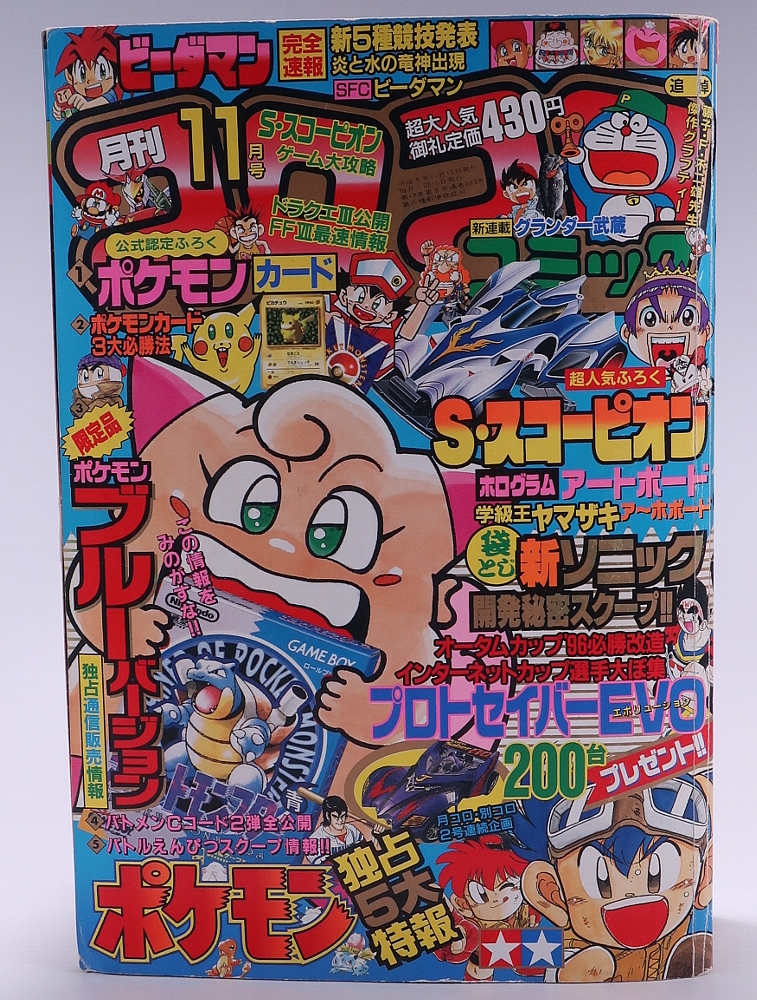
Fun Fact #4: Also in Japan, Media Factory actually printed a version of this card with English text and a gray “PROMO” star, closely (but not perflectly) imitating the appearance of WotC’s English cards! This version was included in the Spring 1999 issue of Hyper CoroCoro, which released on March 1, 1999. Despite being printed in English, however, WotC did not allow these Media Factory cards to be played in sanctioned US events.

#8: Mew LV. 23
2000-01-08
On January 8th, 2000, the third season of the Pokémon Trading Card Game League began, and trainers across the US were finally given the chance to obtain the mysterious 151st Pokémon: Mew! Japan got the LV. 23 Mew as a holo rare in their Fossil set, but WotC claimed that Media Factory agreed that the mythical Mew was better suited for a special promotion than a normal set, so they made it a Black Star Promo instead.
“Okay, sure, fine, but why was it made non-holo?” I’m afraid I don’t know WotC’s official explanation for that choice. I assume they did that so they could release a holo version later. WotC did state in an April live chat that they “had many collector/players complain to us that they did not want to play with their holos and ruin them but wanted to use those cards in game play, so [WotC] made both for [players].” Whatever the reason, they did eventually give us a holo version as well. Keep reading and you’ll see it soon!
Before we get to that, though, it’s finally time for promo #6!

#6: Arcanine LV. 34
2000-02-19
It’s about time! WotC’s official website (archived March 2000) claimed that this Arcanine promo was distributed at leagues in January, but that doesn’t appear to have been the case. That may have been the original plan, but it seems this poky little puppy was running a bit late. When asked about Arcanine promo #6 in a live chat on February 17th, WotC’s Master Trainer on duty responded, “I think this will be the next promo card through the league,” indicating that it still had yet to be distributed as of that night.
In his response, the Master Trainer mentions an article by WotC’s Will McDermott on page 23 of TopDeck #4. The article includes a list of promo cards along with their approximate release months and distribution methods. Although it’s the “March 2000” issue of the magazine, in typical magazine fashion, it was already available in mid-February, if not earlier. Anyhow, the chart in this article lists promo #6 as Arcanine and states that it was to be distributed at official Pokémon leagues in January–February 2000. Well, it seems clear that no January distribution took place in reality—Mew #8 was the league promo for January, and players were still asking about Arcanine #6 in mid-February. McDermott was soon at least partially redeemed, however, when Pokémon Trading Card Game League Season 4 began on February 19th, bringing Arcanine #6 with it. Better late than never!

Base Set 2 released only a week later, making Arcanine #6 the last English promo released before Base Set 2. In other words, if you were to set the cutoff for the “Base–Fossil” format at the release of Base Set 2, then the legal promos would be numbers 1 through 8.
For years, our online Base–Fossil community used that card pool, ending at promo #8 and excluding Base Set 2. However, we voted in 2025 to extend the cutoff beyond Base Set 2, ending instead at the release of Team Rocket. Which promos were added to the pool in that extra two-month window? Keep reading to find out!
Base Set 2 Era Promos
2000-02-24 through 2000-04-23

#14: Mewtwo LV. 60
2000-03-21
“Wait, why are we jumping all the way to #14? What happened to promo numbers 9 through 13?” Excellent question! The answer is “I have no idea.“ I can only point back to a previously mentioned May 2000 live chat, in which WotC reminded fans, “Different promotional cards are worked out with different promotions and companies and they all work at different rates. Some just make it to market earlier than others.”
Anyway, Mewtwo #14 was included with the home video release of Pokémon: The First Movie, available beginning March 21st, 2000. Mewtwo LV. 60 was a format-defining Pokémon in both the Fossil and Rocket eras, so players surely appreciated the chance to get an extra copy for their deck. I know I did!
Next up, we have another Mewtwo promo:

#12: Mewtwo LV. 30
2000-03-?? (Before 2000-04-02)
Oh no, not another vague release window! That’s right, we’re jumping backward from #14 to #12, and we don’t even know precisely when we got it. We do have a pretty good idea, though!
This LV. 30 Mewtwo promo, the first card to be illustrated by a non-Japanese artist (MTG legend Christopher Rush), was included in the April 2000 issue of Nintendo Power. I found a video on YouTube that shows the insert with the Mewtwo card at the 1:00 mark.
Magazines typically hit store shelves weeks before the date on the cover, though, so this one probably arrived sometime in March. We can at least say with confidence that it was available before April 2nd, when a player from Texas ran four copies in his tournament deck. It’s possible this card may have been available before the LV. 60 Mewtwo promo #14 shown above, but we can’t be sure. Either way, both cards landed solidly in the Base Set 2 era, so it doesn’t really matter which came first as far as format legality is concerned.

#13: Venusaur LV. 64
Between 2000-03-31 and 2000-04-23
Speaking of Nintendo Power, it’s only thanks to a business reply card included in the March 2000 issue that I was able to determine a release date for this promo card! Venusaur promo #13 was included with the official Nintendo Power Player’s Guide for the Pokémon Trading Card Game video game for the Game Boy Color. We know that the PTCG videogame itself released in North America on April 10th, but the release dates for the game and the guide didn’t necessarily line up. Fortunately, as you can see in the circled area here, the folks at Nintendo Power were kind enough to let us know that this guide would be available March 31st, 2000. Therefore, it’s reasonable to conclude that Venusaur #13 released March 31st, 2000. That is, if that’s the date it started popping up on store shelves.


To my frustration, I’ve had a hard time finding much other corroborating evidence. It seems it was never a commonly-played card. The only tournament report I’ve found from April in which anyone ran this card took place on April 23rd, the night before Team Rocket‘s official release. The player who wrote the report said he didn’t run any Japanese cards, meaning this was the English print.
Fun fact: In the Pokémon Trading Card Game for the Game Boy Color, this Venusaur LV. 64 has been nicknamed the “Phantom Venusaur.” In Japan, it was a secret card only obtainable through the “Card Pop!” feature. In North America, however, it wasn’t obtainable at all, due to a bug in the coding. Whoops! Thankfully, some clever fans managed to find a way around that, so if you play the video game and you want this card, someone can help you out.

#9: Mew LV. 23
2000-04-01
I told you it was coming! The non-holo Mew promo that was given out during Season 2 of the Pokémon Trading Card Game League got a holographic reprint on April 1st, 2000. Players were able to earn this holo version, promo #9, during Season 5 of the Pokémon Trading Card Game League, which ran from April 1st through May 12th, 2000. As mentioned previously, Japan originally got this holographic Mew card in their Fossil equivalent set, so American fans were quite happy to finally have an English version with the same foil treatment.

#15: Cool Porygon LV. 15
2000-04-03
And ahead we jump once more, to Cool Porygon! This Porygon was packed in a Nintendo 64 console bundle with Pokémon Stadium. Don’t get it confused: Cool Porygon didn’t come with every copy of Pokémon Stadium; it was only included with the specific console bundle. Furthermore, although the game itself released on March 6th, this particular bundle wasn’t available until early April. Of course, March or April, it would still have fallen between the Base Set 2 and Team Rocket sets, so its competitive legality isn’t being called into question. Its competitive viability is another story, though. I hate to say it, but being cool is not the same as being good.

#10: Meowth LV. 13
2000-04-10
The final Black Star Promo card of the Base Set 2 era is the ultra-cute Meowth LV. 13. It was included with the video game for which it was originally designed: the Pokémon Trading Card Game for the Game Boy Color. As previously mentioned, the game released in North America on April 10th, 2000.
Compared to its counterpart in the video game, this Meowth’s Cat Punch attack differs slightly. In the video game, the target of the attack is chosen completely at random! That would be impossible, or at least infeasible, outside of the video game, so the card designers at Creatures aimed to achieve a similar-enough effect using coin flips.
…And with that, we’ve reached the end of the Base Set 2 era. In other words, that’s the last of the English Base–Fossil promos. The next English promo card wouldn’t come out until Season 6 of the League started on May 13th, long after Team Rocket released on April 24th. Meaning…
Nothing beyond this point is legal in the English Base–Fossil format!
Team Rocket Era Promos
2000-04-24 through 2000-08-14

#16: Computer Error
2000-05-13
We’re in the Team Rocket era now, so what better promo to release next than Rocket’s Secret Machine, Computer Error? Trainers were able to earn the Computer Error promo card during Season 6 of the League, which ran from May 13th through June 23rd, 2000. WotC revealed as much in a live chat just two days prior, on May 11th. In the very next sentence, they also revealed the long-awaited promo for Season 7, which was…

#11: Eevee LV. 7
2000-06-24
That’s right, promo Eevee #11! WotC confirmed in May 11th’s live chat that the LV. 7 Eevee promo would be given out at Season 7 of the Pokémon Trading Card Game League, which would begin on June 24th, 2000. This Eevee card, according to WotC, was “a unique mechanic card that has not appeared in Japan.“
In truth, Japanese players could get a version of this card with a different illustration by Toshinao Aoki through the Japanese Pokémon Card Fan Club for 500 “GET!” points beginning April 1st, 2000. (Just for reference, note that Japan was already in their neo era by this point in time!) However, it’s true that the particular illustration by Kagemaru Himeno as seen on our Black Star Promo #11 wouldn’t appear in Japan until August, when an English-language card printed in Japan by Media Factory was given out as a prize for the JR Pokémon Stamp Rally 2000. Similar Japan-produced English-language prints of Meowth #10 and Mewtwo #12 were also given as prizes in the same campaign.
Not-so-fun fact: Unfortunately, WotC made a subtle yet significant error when translating this card’s effect from Japanese. Its Pokémon Power, Chain Reaction, was only meant to activate when one of your Pokémon in play evolves, but WotC’s mistranslation allowed it to work even when one of the opponent’s Pokémon evolved. You can imagine the interruptive chaos this caused. (Though, to be honest, it’s really more fun and interesting that way.)

#21: Moltres LV. 33
2000-07-28
Skipping ahead just a bit, we have a trio of new movie promos. The second Pokémon movie, Pokémon the Movie 2000: The Power of One, premiered in US theaters on July 21st, 2000. For the first week of the movie’s theatrical run, viewers were given the unnumbered, non-Black-Star “Ancient Mew” promo card, but for the second week, fans instead would receive one of Kanto’s three “legendary bird” cards: Articuno #22, Zapdos #23, or Moltres #21. Why are they out of order? I don’t know, but it bugs me, too.
These legendary bird promos were originally illustrated by Toshinao Aoki and distributed in Japan through the All Nippon Airways (ANA) “Everyone’s Happy Campaign” in the summer of 1999. The WotC Black Star Promo versions featured exclusive new illustrations by Naoyo Kimura. Initial English prints of these promos erroneously still credited Toshinao Aoki for the new illustration, but this mistake was fixed for later prints and other languages.


#22: Articuno LV. 34
2000-07-28
The second of the three new Black Star Promos distributed during week two of the theatrical run of the second Pokémon movie, Pokémon the Movie 2000: The Power of One, was the LV. 34 Articuno #22. These legendary bird promos were originally illustrated by Toshinao Aoki and distributed in Japan through the All Nippon Airways (ANA) “Everyone’s Happy Campaign” in the summer of 1999. The WotC Black Star Promo versions featured exclusive new illustrations by Naoyo Kimura. Initial English prints of these promos erroneously still credited Toshinao Aoki for the new illustration, but this mistake was fixed for later prints and other languages.

#23: Zapdos LV. 30
2000-07-28
The third of the three new Black Star Promos distributed during week two of the theatrical run of the second Pokémon movie, Pokémon the Movie 2000: The Power of One, was the LV. 30 Zapdos # 23. These legendary bird promos were originally illustrated by Toshinao Aoki and distributed in Japan through the All Nippon Airways (ANA) “Everyone’s Happy Campaign” in the summer of 1999. The WotC Black Star Promo versions featured exclusive new illustrations by Naoyo Kimura. Initial English prints of these promos erroneously still credited Toshinao Aoki for the new illustration, but this mistake was fixed for later prints and other languages.

#17: Dark Persian LV. 28
2000-07-??
Time to jump back a bit on the number line to #17. Probably originally intended to be released in the spring, closer to the Team Rocket set release, this alternate-art reprint of Dark Persian TR 42 was apparently delayed due to misprints. (Specifically, they were printed without HP.) Some of those HP-less misprints made their way into circulation, but they’re rare, and they aren’t cheap!
Anyway, it was delayed a bit, but it eventually released in the August 2000 issue of Nintendo Power magazine (Volume 135). This issue probably started popping up sometime in July, but we can’t be sure of an exact date. Nintendo Power’s website stated that subscribers should never have to wait past the 15th of a given month to receive that month’s issue, which would mean that the absolute latest this issue should have arrived for any subscriber would have been August 15th, but it was probably available a few weeks earlier. (As mentioned previously, we usually can’t nail down a specific date for any magazine issue, but they typically found their way to newsstands sometime during the month before the month on the label, meaning the August issue was likely already available by late July.)


#18: Team Rocket’s Meowth LV. 11
2000-08-05
Season 8 of the Pokémon TCG League began on August 5th, 2000, and players were given the opportunity to earn another Black Star Promo card: Team Rocket’s Meowth. As a “Team Rocket’s” Pokémon, Team Rocket’s Meowth was different from both the “Dark” Pokémon of the Team Rocket set and the “Rocket’s” Pokémon of the upcoming Gym Heroes and Gym Challenge sets.
Speaking of which, Gym Heroes would go on sale less than two weeks later, on August 14th, kicking off the Gym era, while and Promos #19 and #20 wouldn’t release until later. This means Team Rocket’s Meowth #18 was the last Black Star Promo of the Team Rocket era.
That’s it for now, but I’ll update this post soon with promos from the Gym era, wrapping up Gen 1. A little later on, I’ll update it again with all the Neo and e promos as well, completing the timeline. Look forward to it!
Until then,
🥥 Coco
Leave a Reply